Planting and Irrigation
Which Plants Do Well Around a Central Valley Water Feature?
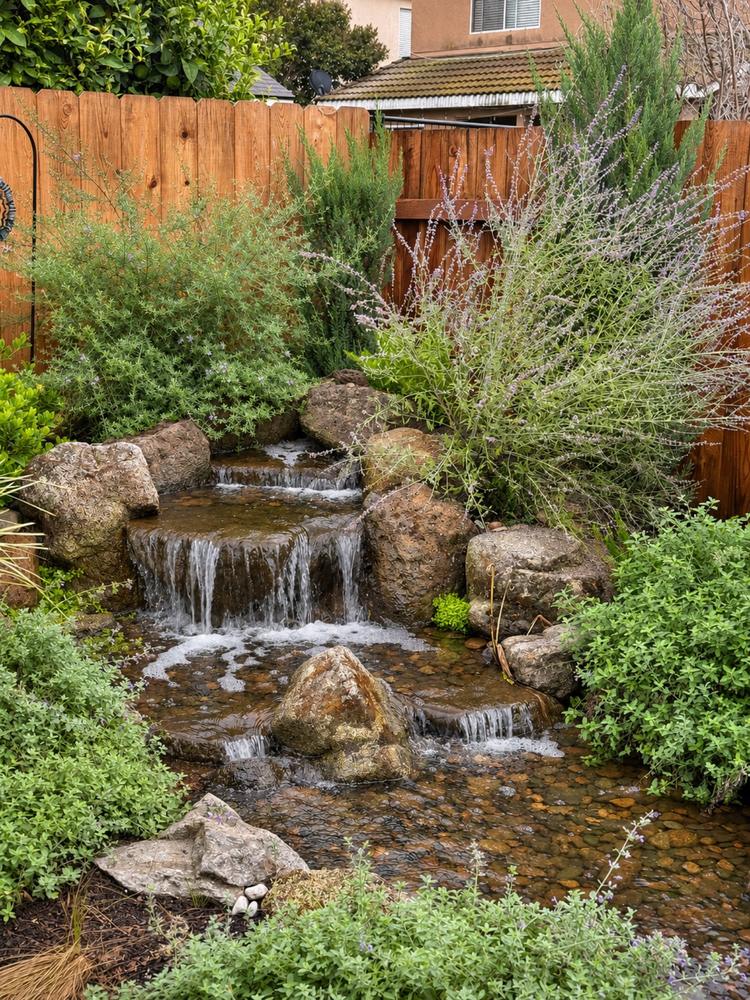
A pond or waterfall looks finished when the planting makes it look like it was always there. In the Valley the trick is choosing plants that look lush beside water without needing pond-level water themselves, and keeping the ones that do need it apart from the ones that don't.
Start With the Central Valley Ratings
WUCOLS, the Water Use Classification of Landscape Species from the California Center for Urban Horticulture at UC Davis, rates how much irrigation landscape plants need in each of six California regions. Its database puts Modesto, Turlock and Tracy in Region 2, the Central Valley, which its manual matches to Sunset climate zones 8, 9 and 14.
Each plant gets one of four ratings, set as a share of reference evapotranspiration, the water lost by a large field of well-watered, cool-season grass:
- High: 70 to 90 percent.
- Moderate: 40 to 60 percent.
- Low: 10 to 30 percent. The manual calls these water conserving.
- Very low: under 10 percent, needing no irrigation except in years of below-average rain.
The ratings are for established plants, which the manual says generally happens by the second or third year after planting.
Group Plants by Water Need
WUCOLS calls grouping plants with similar water needs one key strategy for a water-efficient landscape. The UC Master Gardeners of Stanislaus County call it hydrozoning: plants that need the same amount of water share an irrigation line. Their advice for the odd thirsty plant is to move it to its own hydrozone or put it in a pot, rather than watering the whole bed extra.
Around a water feature this matters more than anywhere. A bog plant and a lavender can stand a foot apart, but they should not share a valve.
At the Water's Edge
These three give a pond or stream the look of a natural bank. All three are UC Davis Arboretum All-Stars, part of a lineup of 130 plants chosen to handle hotter, drier conditions:
- California gray rush (Juncus patens). Upright, gray-green stems up to 2 feet tall, for sun or shade. WUCOLS rates it moderate in the Central Valley and notes it can grow in shallow water and goes dormant in summer if grown dry. The Arboretum says it tolerates heavy clay and poor drainage.
- San Diego sedge (Carex spissa). A blue-gray, bunching sedge 3 to 4 feet tall that does not run. WUCOLS rates it low in the Central Valley and notes it is native to streamsides and seasonally wet places and accepts periodic flooding.
- Cape rush (Elegia or Chondropetalum tectorum). Stiff, evergreen, architectural stems about 3 to 4 feet tall. WUCOLS rates it low in the Central Valley and notes it grows near the coast of South Africa, often in marshes or seeps.
On the Bank Behind It
Step back from the edge and the planting can go lower in water. WUCOLS rates each of these low for the Central Valley:
- Lavender. Wants good to excellent drainage and good air circulation. The Arboretum's All-Star, 'Otto Quast' Spanish lavender, thrives in sunny, dry conditions.
- Russian sage (Perovskia). Lavender-blue flowers in mid- to late summer. Full sun and well-drained soil.
- Deer grass (Muhlenbergia rigens). A California native bunchgrass with tall flower plumes. An All-Star the Arboretum calls a great accent for texture in a low-water garden.
- Autumn sage (Salvia greggii). An All-Star that blooms from March to January and draws hummingbirds.
- Catmint (Nepeta). The Arboretum's All-Star hybrid catmint is a low border plant, about a foot tall, with lavender flowers in spring and summer.
For the shady side of a feature, the Arboretum lists the Pacific Coast iris 'Canyon Snow' and island alumroot (Heuchera maxima) as All-Stars for part shade to shade.
Plants That Belong in the Water
Some favorites for a pond's edge need far more water than the rest of a Valley garden. WUCOLS rates these high for the Central Valley:
- Sweet flag (Acorus).
- Umbrella sedge and papyrus (Cyperus).
- Horsetail (Equisetum).
- Japanese iris (Iris ensata).
- Taro (Colocasia).
If you want them, give them their own wet spot: on a pond's plant shelves, or in a zone of their own. Mixed into a low-water bed, they either struggle or make the whole bed get watered like a bog. A pondless waterfall has no open pool, so it has no place for water plants; see Pond or Pondless Waterfall.
Give New Plants Time
The Stanislaus Master Gardeners point out that even water-wise plants need regular water until they are established, which can take 2 to 3 years for shrubs and 4 or more for trees. They also recommend 2 to 4 inches of woody mulch, kept 4 to 6 inches away from plant stems, to cut evaporation and weeds.
How We Plan It
Every Green Lion pond and pondless feature recirculates, and the planting around it goes on drip. We design the planting with the water feature, so the edge plants, the bank and any water plants each sit on the irrigation they need. See the ponds and waterfalls we build in Modesto, or ask us to show your yard in 3D, free with the purchase of a 2D design.
Sources
- WUCOLS (Water Use Classification of Landscape Species), California Center for Urban Horticulture, UC Davis
- WUCOLS Plant Search Database (Region 2, Central Valley ratings)
- WUCOLS IV User Manual (PDF)
- UC Davis Arboretum and Public Garden: Arboretum All-Stars
- UC Davis Arboretum: All-Star Plant Info Cards (PDF)
- UC Master Gardeners of Stanislaus County: Sustainable Landscaping
Checked November 24, 2026. Rules, programs and prices change; confirm with the agency or maker before you start.