
Pavers and Patios
Pavers or Stamped Concrete: Which Is Better for a Valley Patio?
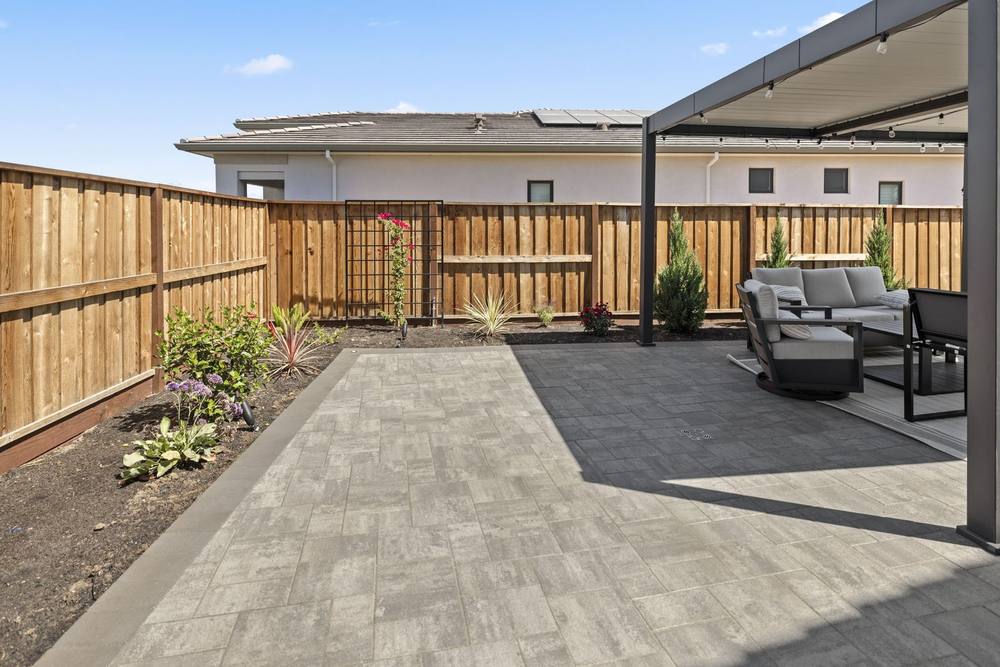
Both give you a hard, flat patio that can be colored and patterned. The difference shows up years later: one is hundreds of separate units, the other is a single slab. That changes how each one handles cracks, repairs and upkeep.
How Each One Is Built
Pavers are individual concrete units laid on a bed of sand over a compacted crushed-stone base. Sand is swept into the narrow joints between them, and an edge restraint holds the field in place. The Concrete Masonry and Hardscapes Association, the industry group that now includes ICPI, says paver joints are typically specified at 1.5 to 3 mm.
Stamped concrete is a poured slab that is colored, pressed with texture mats while it is still workable, then sealed. Joints are cut or tooled into it so it cracks where you want it to.
Cracking
The National Ready Mixed Concrete Association is plain about it: all concrete tends to crack, and completely crack-free concrete is not possible. Joints are "simply pre-planned cracks." NRMCA recommends spacing them no more than 24 to 36 times the slab thickness, which is about 10 feet for a 4-inch slab, so any patio wider than that gets joint lines across its stamped pattern.
To be fair to concrete, NRMCA also notes that most random early cracks, though unsightly, rarely affect the strength or service life of the slab. The trouble is that on a decorative surface, the look is the point.
A paver patio is already divided by hundreds of joints, so there is no single slab to crack. If one paver does crack, CMHA says a crack with little or no opening generally won't affect performance, and a damaged paver is simply replaced.
Summer Pours Need Care
NRMCA's hot-weather guidance explains that high temperatures, low humidity and wind dry new concrete fast, which can cause shrinkage cracks before it sets. A slab poured on a hot day followed by a cool night can also crack from the temperature swing. NRMCA recommends avoiding the hottest part of the day for placing and finishing, and a good concrete crew plans around this. Pavers need no curing on site, so the weather on install day doesn't change the units themselves.
Repairs
This is where pavers pull ahead. CMHA describes pavers as a "zipper" in the pavement: an area can be opened, the problem underneath fixed and the same pavers put back, with no patch and no curing time. A sunken spot can be lifted, the base corrected and the pavers reinstalled "with no wasted paving materials or unsightly patches." That matters when you later add a gas line for a fire pit, wire for lighting or a new irrigation line.
Stamped concrete has no such option. A crack can be filled and sealed, or a section cut out and poured again, and a patch may not match the older color and texture exactly.
One tip: keep a few spare pavers from the same order. A matching paver makes the easiest repair there is.
Upkeep
- Pavers. CMHA recommends a check and sweep in spring and fall. If the joint sand drops more than 1/2 inch, top it up with dry masonry sand, and take care with a pressure washer so you don't blast the sand out. Sealing is optional; it makes stains easier to clean, which helps around a grill. New pavers can show a white haze called efflorescence. CMHA says it is cosmetic, stops on its own and can be cleaned off.
- Stamped concrete. The sealer is a wearing coat that has to be renewed. The American Society of Concrete Contractors' rule of thumb is new sealer every two to three years for sunny, busy areas, timed by faded or patchy color rather than strictly by the calendar. Slip resistance has to be addressed at every reseal, usually with an anti-slip additive, and ASCC advises sealing when the slab is cooling, not heating up, which in summer can mean working in the evening.
What Drives the Cost
We don't publish prices, because the same square footage can cost very different amounts. What moves the number: the size and shape of the patio, how much digging and base work the soil needs, access for equipment, removing an old slab or lawn, the paver line or stamp pattern and color, borders and curves, and how many cuts the layout needs. You get a written price after we see your yard.
Which We'd Choose
For most patios, pavers: no single slab to crack, repairs without a patch, and room to add a gas line, lighting or a water feature later without breaking anything. Stamped concrete can make sense for a simple, flat area where you accept that some cracking may show and you are happy to keep up the sealer. We build both, and porcelain too. See our pavers and decorative concrete work and recent patios. We can show you the patio in 3D before we build, free with the purchase of a 2D design.
Sources
- Concrete Masonry & Hardscapes Association (formerly ICPI): PAV-TEC-006 Operation and Maintenance Guide for Interlocking Concrete Pavement
- Concrete Masonry & Hardscapes Association: Segmental Pavement
- NRMCA Concrete in Practice 4: Cracking Concrete Surfaces
- NRMCA Concrete in Practice 6: Joints in Concrete Slabs on Grade
- NRMCA Concrete in Practice 12: Hot Weather Concreting
- American Society of Concrete Contractors, Decorative Concrete Council: Sealing Stamped Concrete
- American Society of Concrete Contractors: Concrete Sealer Expectations and Maintenance Guide
Checked November 24, 2026. Rules, programs and prices change; confirm with the agency or maker before you start.