
Outdoor Living
What Landscape Lighting Works Best Around a Water Feature?
Lighting a water feature takes two kinds of fixtures: lights made to sit in the water, and lights around it. The fixtures below are all low-voltage LED, run from a transformer, and their makers are specific about how to install them near water. Here is what their spec sheets and guides say.
Lights in the Water
An underwater light has to be built for full-time submersion. Two examples, Vista's 2119 and Kichler's VLO, are both 12-volt LED fixtures. What to look for:
- A rating for submersion. Kichler says the VLO's IP68 rating allows it to be fully submerged in a pond, stream or fountain. Vista lists the 2119 as rated for submersive and wet locations.
- Corrosion-resistant metal. The 2119 is machined from solid brass or stainless steel. The VLO housing is 316 stainless steel, made for all types of water.
- A long lead. The 2119 comes with a 15-foot pigtail of 18/2 double-jacketed, water-resistant cable, and the VLO with 25 feet of wire lead. That length lets the wire connection sit away from the water.
- Safe for fish. Kichler says the VLO is safe for aquatic wildlife and virtually any water additives.
Both are compact. Vista says the 2119's design allows for discreet placement in ponds, alongside waterfalls or near fountain nozzles. The VLO lets you switch between 100, 200 and 400 lumens with a magnetic key, even underwater.
Lights Around the Water
Tru-Scapes' guide to lighting ponds and fountains combines three kinds of fixtures:
- Submersible LEDs at the bottom of the pond or fountain, aimed up to catch the moving water. In deeper ponds, space them evenly to avoid dark spots.
- Spotlights around the edge, angled slightly inward, or a narrow beam aimed at a waterfall to catch the spray.
- Path lights around the feature, to frame it and guide people safely.
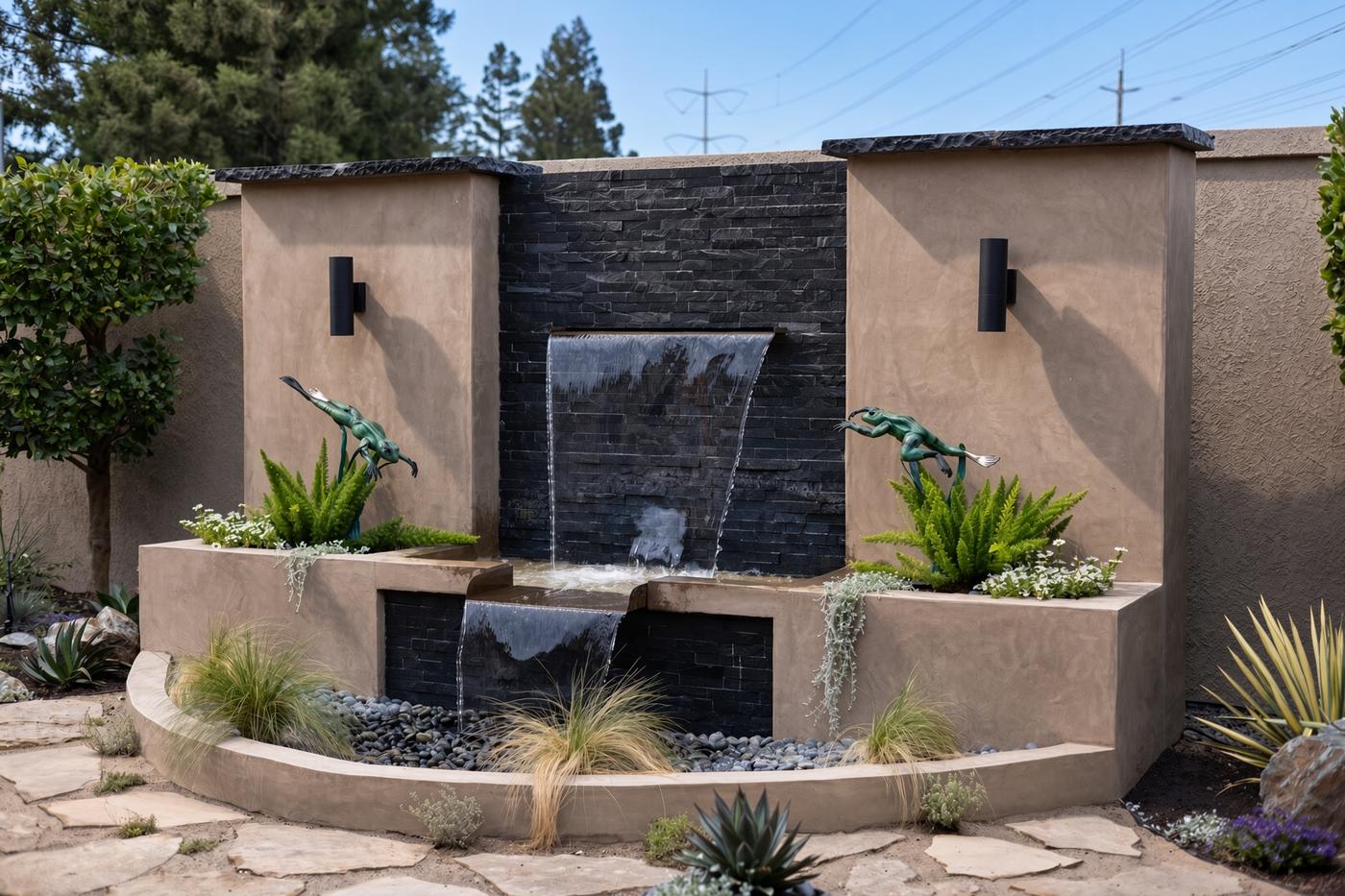
A water wall can carry its own light, like the wall sconce on each column in the photo above. Kichler's VLO also works out of the water: mounted on a patio or pergola, it can light the rocks and plants around a feature.
On color, Tru-Scapes recommends warm white or soft amber and says harsh cool whites can make water look sterile. The VLO is 3000K, and Vista offers the 2119 in 3000K, 4000K and 5000K.
Safety Rules From the Makers
Vista's installation instructions for the 2119 show the kind of rules that come with an underwater light. Follow the sheet for the exact fixture you use.
- Low-voltage power only. Use it only with a low-voltage landscape power unit of no more than 25 amps and 15 volts.
- Code first. Install it to the National Electrical Code and local codes.
- Power off to work. Disconnect the transformer from its power supply before installing or servicing.
- Splice on dry land. Make any connection or splice above the waterline and at least 4 feet from the water's edge. The end of the underwater cable must be sealed (potted) so moisture can't get in.
- Leave the seal alone. Don't pull the underwater cable or loosen its connector. Either can break the factory seal.
- Shallow cable. Don't bury the secondary cable more than 6 inches deep.
- No pools or spas. The 2119 is not for swimming pool or spa use and must not be installed within 10 feet of a pool or spa. Keep that in mind if a hot tub sits near the water feature.
- Hot to the touch. Depending on lamp wattage, the lens and metal can get hot enough to blister hands, so keep higher-wattage fixtures out of small children's reach.
- Stay within the transformer. The total fixture load must not exceed the transformer's rating, and no extension cords on power units.
Tru-Scapes' advice for homeowners is simple: if you're unsure about wiring near water, call a pro.
Size the Transformer With Room to Spare
Tru-Scapes says to add up the wattage of every fixture on the transformer, then pick one your total load fills to about 70 to 80% of its capacity. That leaves room for voltage swings, longer wire runs and lights you add later. Its chart:
- 1 to 70 watts of fixtures: a 100-watt transformer.
- 71 to 160 watts: a 200-watt transformer.
- 161 to 320 watts: a 400-watt transformer.
It recommends at least 12/2 low-voltage direct-burial wire, and heavier wire for larger systems or long runs.
Keep Them Clean
Underwater lights collect algae and debris. Tru-Scapes suggests checking them monthly, pulling them out every few months to wipe them off, and trimming back plants that block the beams. Disconnect the power first, as Vista's instructions say.
How We Plan It
Our low-voltage LED lighting covers spotlights, uplights, wall sconces and path lights. We plan the lighting with the water feature, along with the paving and planting, so the yard reads as one design. See our landscape lighting and the water features we build.
Sources
- Vista Professional Outdoor Lighting: 2119 Low Voltage Underwater Fixture
- Vista Professional Outdoor Lighting: 2119 Installation Instructions (PDF)
- Kichler: VLO 3000K 12V LED Underwater Accent (16027SS30)
- Tru-Scapes: How to Illuminate Water Features with Landscape Lighting
- Tru-Scapes: What Size Transformer Do I Need?
Checked November 24, 2026. Rules, programs and prices change; confirm with the agency or maker before you start.